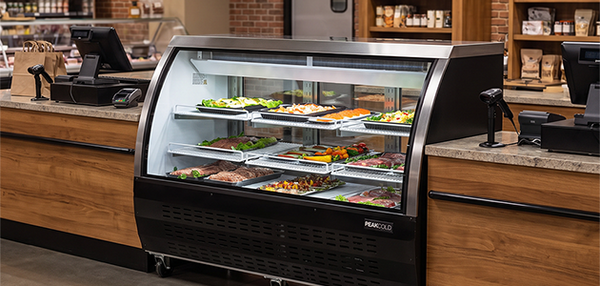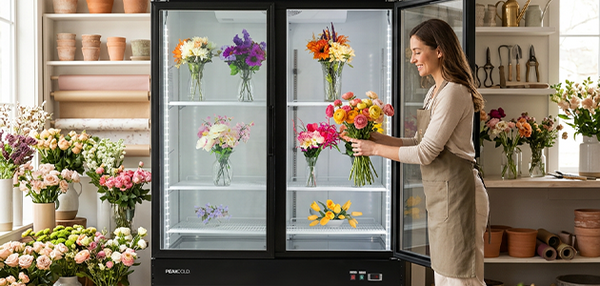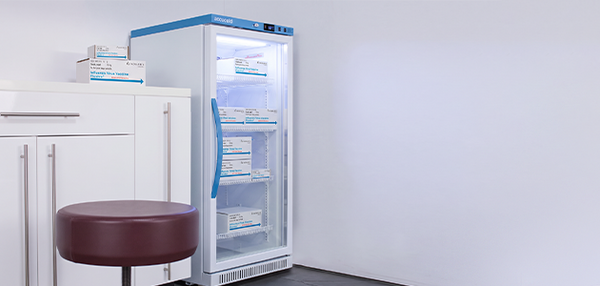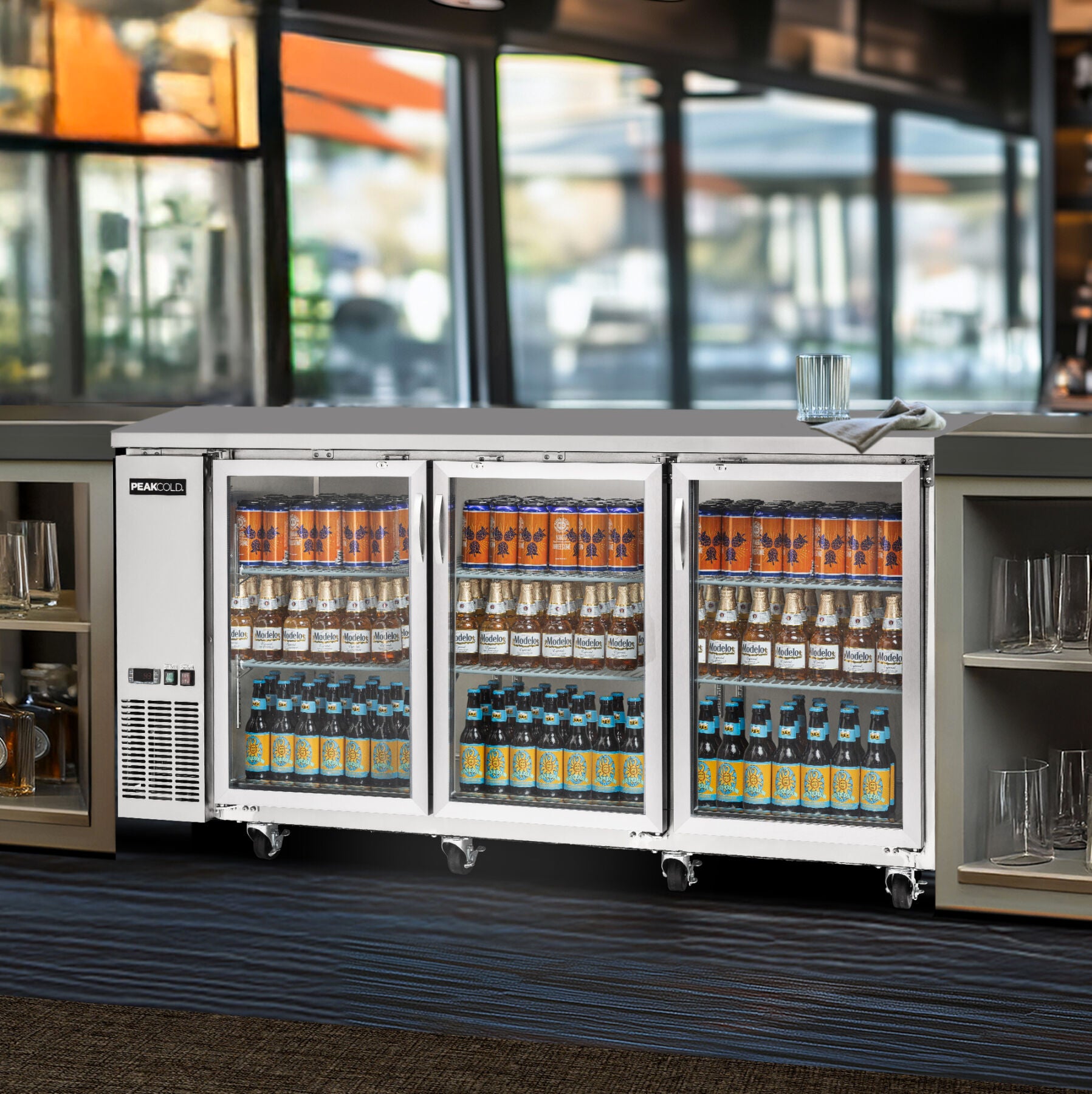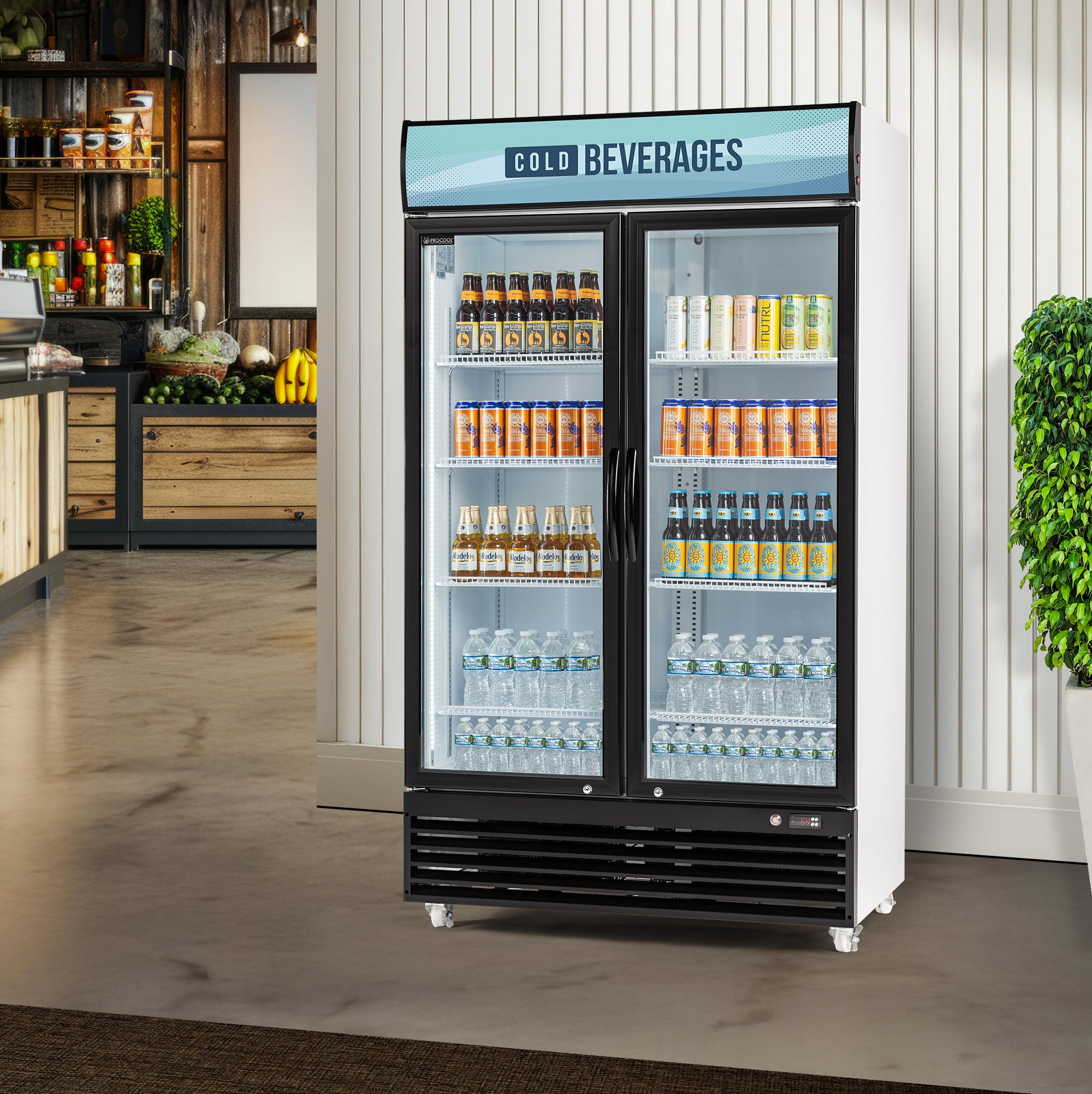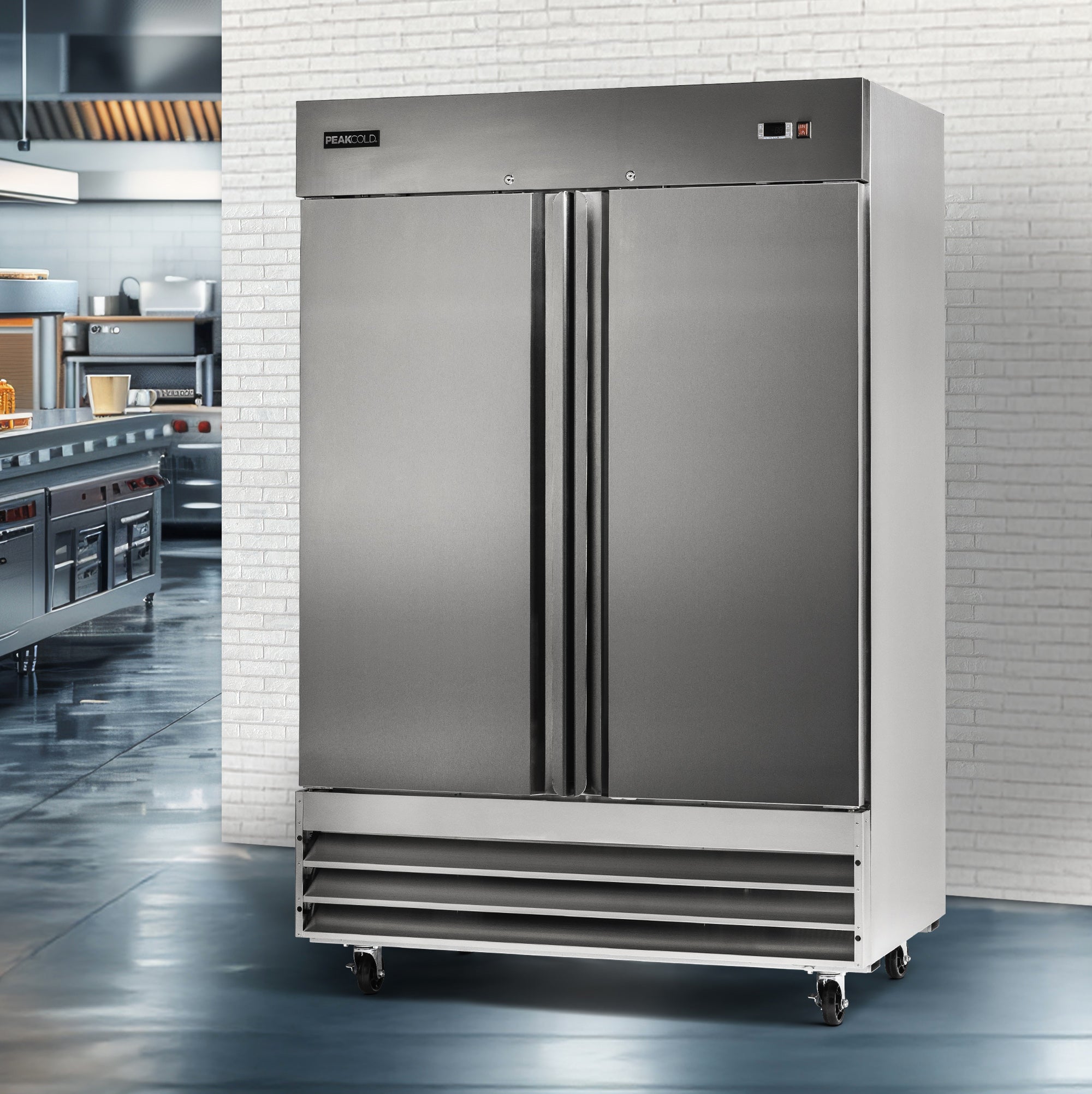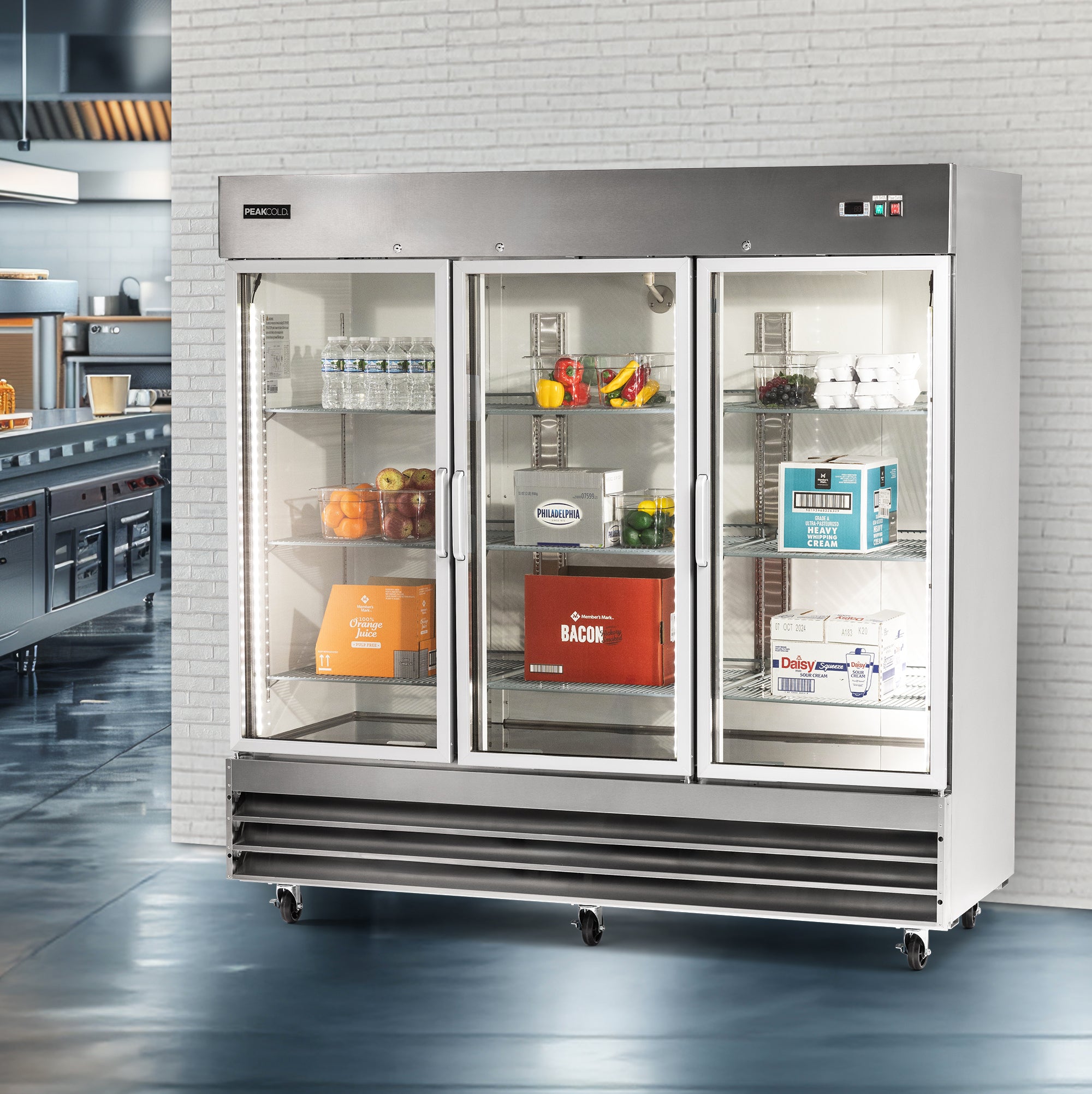

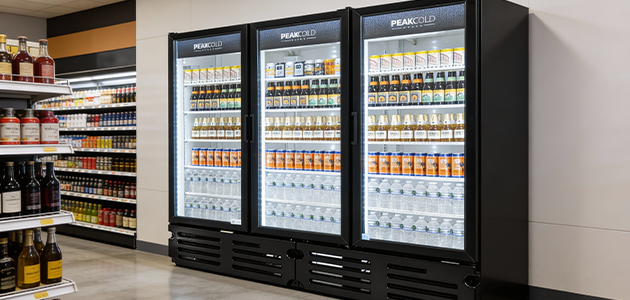
Most convenience store cooler decisions come down to three formats. Glass door reach-in merchandisers give the most packaged beverage capacity per square foot at the lowest running cost. Open air coolers drop the door so a customer grabs a sandwich in one motion, which lifts impulse pickup but costs more to run. Specialty cases, mainly deep well bottle coolers and milk coolers, handle high-turn single-serve. All three must hold potentially hazardous food at 41 degrees F or below.
The Three Convenience Store Cooler Formats
Glass Door Reach-In Merchandisers
Glass doors carry the packaged drink program in bodegas, gas stations, and campus stores. Countertop cases hold under 3 cubic feet. A single-door unit near 24 inches wide runs 12 to 19 cubic feet, a two-door at 39 to 47 inches holds 35 to 45, and a three-door at 72 to 78 inches reaches 53 to 66. Sliding doors save aisle space.
Open Air Coolers
An open-air cooler holds product behind a downward-moving air curtain instead of a door. Vertical models commonly run 24 to 30 inches wide, 75 to 81 inches tall, and 12 to 16 cubic feet. They earn their keep on sandwiches, salads, and cut fruit, where a two-second grab beats a door pull at lunch rush. Our grab-and-go menu guide covers the product side; the bakery display case buying guide handles pastries.
Deep Well Bottle Coolers and Milk Coolers
Horizontal deep well bottle coolers use sliding top lids and wire dividers to separate brands. They run about 27 to 95 inches wide and belong beside a register. Campus and school operators rely on milk coolers, sized by crate: 8 crate units are about 34 inches wide, 12 crate 49 inches, 16 crate 58 inches.
Cooler Format Comparison at a Glance
|
Format |
Typical capacity |
Energy |
Best use |
Relative cost |
|
Glass door reach-in |
3 to 66 cu ft |
Lowest |
Packaged drinks |
Low to run |
|
Open air cooler |
12 to 16 cu ft per section |
Highest |
Grab and go food |
Highest to run |
|
Deep well bottle cooler |
Under 8 to 20 cu ft |
Low to moderate |
Bottles at checkout |
Low |
|
Milk cooler |
8, 12, or 16 crates |
Low |
Single-serve milk |
Low |
Open Air Versus Glass Door: The Real Tradeoff
Infiltration drives more than 70 percent of the refrigeration load in an open case, since room air mixes into the air curtain. Research measured open lineups using roughly 1.3 times the energy of doored lineups per foot, and retrofit studies report savings of 23 to 73 percent once doors go on. Product temperature is less stable at the outer facings too, and one ASHRAE field study found no dairy or beer sales drop after a door retrofit. Use an open-air cooler where speed of service drives sales; glass doors everywhere else. Compare models on the ENERGY STAR commercial food service equipment list.
Air Curtains, Load Lines, and Store Temperature
An open case only performs if the air curtain stays intact:
-
Never stock above the load line. Product above it sits outside the air curtain.
-
Leave about 1 inch of air space above each product tier.
-
Keep at least 4 inches of clearance from the discharge fan.
-
Load product already cold. An open case holds temperature; it cannot pull it down.
Ambient store temperature matters more here than in any other format. Many open-air merchandisers are rated to NSF Type I conditions of 75 degrees F and 55 percent relative humidity, with Type II at 80 degrees F, so a store that drifts warm in summer pushes the case out of spec. Confirm the rules in the FDA Food Code and check storage times on the FoodSafety.gov chart.
Sizing by Linear Feet
Plan cold vault space in linear feet of wall, not cubic feet:
-
Measure the usable wall run, then subtract door swing and traffic clearance.
-
Divide by section width; doors commonly land near 24, 30, or 39 inches.
-
Count the facings your top SKUs need at peak, not average.
-
Add 10 to 15 percent headroom for deliveries.
Shelving, Planograms, and Lighting
Eye level is buy level. Put high-margin single-serve items on the second and third shelves from the top, roughly 48 to 60 inches off the floor, and push multipacks to the bottom shelf. Give each top SKU a minimum of two facings so it reads full at close.
LED lighting is standard, draws less power than fluorescent tubes, and adds less heat inside the cabinet. Keep door graphics restrained: supplier decals drive category sales, but covering a third or more of the glass hides product.
Condenser Placement and Layout
Self-contained cases use a bottom- or top-mounted condenser. Bottom mount is easier to service but pulls floor-level dust. Top mount keeps the coil above the debris line, which is better in gas stations and campus stores. Leave the specified clearance behind and above the cabinet, clean the coil on schedule, and keep units clear of cooking equipment, direct sun, and door drafts.
Frequently Asked Questions
What temperature should a convenience store cooler be set to?
Any case holding sandwiches, dairy, cut fruit, or other potentially hazardous food must hold 41 degrees F or below, the FDA Food Code cold holding limit. Most operators set 34 to 38 degrees F so even the warmest facing stays compliant. Packaged beverages sit in the mid to upper 30s.
Do open coolers cost more to run than glass door coolers?
Yes. Room air continuously infiltrates an open case, and infiltration accounts for more than 70 percent of its refrigeration load. Measured comparisons put open lineups at roughly 1.3 times the energy of doored lineups per linear foot. Night curtains recover part of that gap.
How many convenience store cooler doors do I need?
Count peak-day facings rather than your average. A small bodega often runs two to four doors, a gas station cold vault runs eight to sixteen, and a campus store lands in between. Add 10 to 15 percent above current sales so deliveries have somewhere to land.
Can I put an open-air cooler near the store entrance?
It is risky. Entry drafts, HVAC diffusers, and ceiling fans disrupt the air curtain and push product out of temperature. Most open cases are rated only to around 75 degrees F ambient. Place them on an interior wall or beside the checkout, where airflow is calm.
Choosing the Right Cooler for Your Store
Start with the product mix, not the equipment. Packaged drinks and backstock belong behind glass, impulse food in an open case, single-serve bottles and milk crates in a purpose-built unit. Match your linear feet to your facings, then compare the retail display coolers from PeakCold and Procool that fit your wall run.