

A vaccine that drifts even a few degrees outside its storage range can lose potency with no visible warning sign, which is exactly why "medical grade" means something specific in this category rather than just a marketing label. A medical grade refrigerator is a purpose-built unit engineered to hold a narrow, documented temperature band, not simply to stay cold.
For refrigerated vaccines and most biologics, CDC guidance calls for 36 to 46 degrees F (2 to 8 degrees C), with the unit aimed at roughly 40 degrees F (5 degrees C). Getting there takes forced-air circulation, microprocessor control, calibrated monitoring, and alarms- features a household refrigerator simply does not have. That is why clinics, pharmacies, dental and veterinary practices, and labs buy purpose-built.
What Makes a Medical Grade Refrigerator Different
The term is not legally protected, so read the spec sheet. A unit built for biologics has:
-
Forced-air circulation. A fan holds shelves within a tight band top to bottom and recovers fast after a door opening.
-
Microprocessor control with a digital display, so you set a number and read the chamber from outside.
-
High and low temperature alarms, audible and visual, ideally with door-ajar and power-failure alerts.
-
A probe port for a calibrated buffered probe and data logger.
-
A controlled defrost strategy. Household frost-free defrost heaters can push the chamber out of range; purpose-built units use cycle or manual defrost tuned to the setpoint.
-
A door lock and a rated storage volume that reflects usable space, not door bins.
NSF/ANSI 456 is a voluntary vaccine storage standard published in 2021 by a joint committee that NSF International convened with CDC and other stakeholders. Certified units are tested for temperature stability, recovery after door openings, alarm performance, and honest capacity labeling.
Medical Grade Refrigerator vs Household Refrigerator
|
Factor |
Household refrigerator |
Medical grade refrigerator |
|
Control |
Dial thermostat, no numeric setpoint |
Microprocessor with external readout |
|
Airflow |
Passive, cold spots near the freezer vent |
Forced air for uniformity and recovery |
|
Alarms |
None |
High and low temp, door ajar, power failure |
|
Monitoring |
Add your own thermometer |
Probe port for a buffered probe |
|
Defrost |
Frost-free cycle can spike interior temperature |
Defrost tuned to the setpoint |
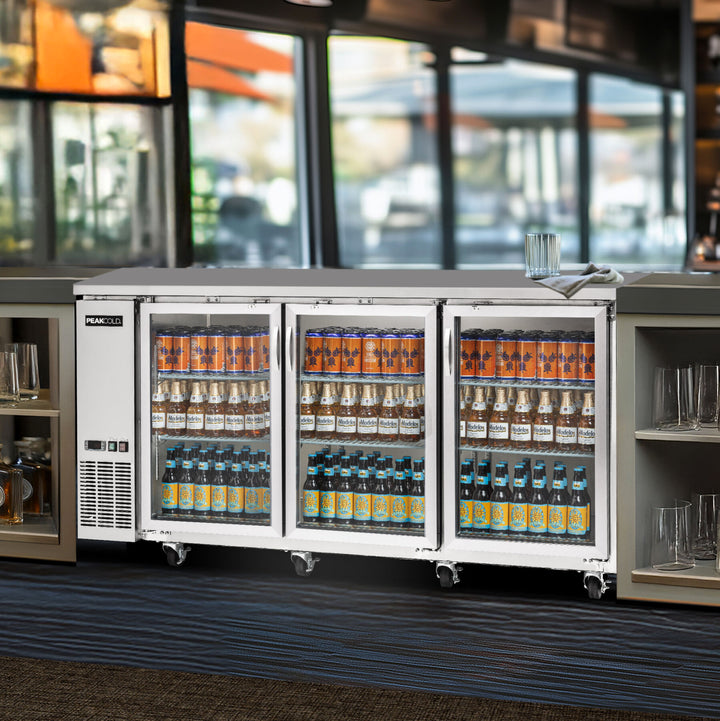
CDC is blunt about dormitory-style and bar-style combination units, meaning one exterior door with a small freezer compartment inside. Those must never hold vaccine, not even temporarily. In NIST testing, the set point on a dormitory-style unit drifted roughly 5 degrees C colder inside two weeks and froze the vaccine it held.
CDC Temperature and Monitoring Requirements
Refrigerated vaccines belong at 36 to 46 degrees F (2 to 8 degrees C). Frozen vaccines belong at -58 to +5 degrees F (-50 to -15 degrees C) in a separate stand-alone freezer, never the freezer compartment of a household unit. Follow the CDC vaccine storage and handling guidance plus your state or program rules; Vaccines for Children providers face added requirements.
Monitoring Devices and Temperature Logs
-
Use a digital data logger with a detachable probe buffered in glycol, glass beads, or sand, recording at least every 30 minutes and sitting with the product mid-cabinet.
-
Keep a current Certificate of Calibration Testing for every device, recalibrated every two to three years or per the manufacturer. Accuracy is typically plus or minus 0.5 degrees C.
-
Record minimum and maximum readings at the start of each workday. Without a min/max function, log the current temperature twice daily.
Sizing and Loading a Vaccine Storage Refrigerator
Size for your busiest week, then add headroom. Medical-grade refrigerators start with countertop and undercounter models from 1 to 6 cubic feet, which suit a single-provider dental or veterinary practice. Mid-size uprights of 8 to 16 cubic feet fit busy clinics and retail pharmacies, and large uprights reach roughly 49 cubic feet for high-volume sites. Compact units generally run $1,000 to $3,000, with full-size uprights closer to $2,500 to $8,000.
Loading rules matter as much as capacity:
-
Keep product in open bins in the center of the cabinet, 2 to 3 inches off walls, floor, ceiling, and vents.
-
Never store product in the door or crisper drawers. Fill those spaces with water bottles instead.
-
Leave gaps between containers. A packed shelf creates warm pockets.
-
Keep food out of the unit.
Under a 36-inch counter, the same clearance and ventilation rules apply as any undercounter refrigerator installation. Compare form factors across undercounter refrigerators and specialty refrigeration.
Power, Backup, and Excursion Planning
Give the unit a dedicated outlet; one storage unit per outlet. Avoid GFCI outlets, outlets on a wall switch, and multi-outlet strips. Use a safety-lock plug or outlet cover, post "DO NOT UNPLUG" signage, and label the breaker.
Most medical-grade refrigerators run on a standard 115V circuit, though you should confirm amperage draw; our refrigerator voltage primer covers the basics. Larger sites should plan generator backup.
Write your excursion protocol first. Label affected product "do not use," hold it at proper temperature, and contact the manufacturer and your immunization program for a viability call. If a unit trends warm, check coils, gasket, and airflow first, since a refrigerator running warm usually has a mechanical cause. For non-clinical cold storage, the ENERGY STAR commercial food service equipment lists are a good efficiency reference.
Frequently Asked Questions
Can I use a household refrigerator to store vaccines?
Only as a fallback, and only the refrigerated compartment of a stand-alone household unit, with frozen product in a separate stand-alone freezer. A medical-grade refrigerator is strongly preferred, because household models have cold spots and wide temperature swings. Dormitory-style and bar-style units are prohibited outright.
What temperature should a pharmacy refrigerator be set to?
Set a pharmacy refrigerator holding vaccines to about 40 degrees F (5 degrees C), centering the cabinet in the required 36 to 46 degrees F window. That leaves margin on both sides during door openings and defrost. Confirm each product's package insert.
How often do I need to record refrigerator temperatures?
Record minimum and maximum readings at the start of every workday, then initial and date the log. If your device has no min/max display, log the current temperature twice daily, once in the morning and once before closing. Review the sheet for near-misses rather than filing it, and retain completed logs for the period your immunization program requires, commonly three years.
What size vaccine refrigerator does a small clinic need?
Base it on peak-season vial volume, not an average month. Many small practices are served by a compact 4 to 6 cubic foot unit, while clinics running seasonal flu campaigns need mid-size uprights. Door bins and drawers do not count.
Choosing a Medical Grade Refrigerator for Your Practice
Start with peak inventory, confirm the feature list above, then budget monitoring alongside the cabinet. Browse pharmacy and medical refrigeration, including Accucold's countertop through 49 cubic foot models, to compare capacities, door styles, and alarms. This article is general guidance, not medical, legal, or regulatory advice; follow the CDC Vaccine Storage and Handling Toolkit and your state or program requirements.