
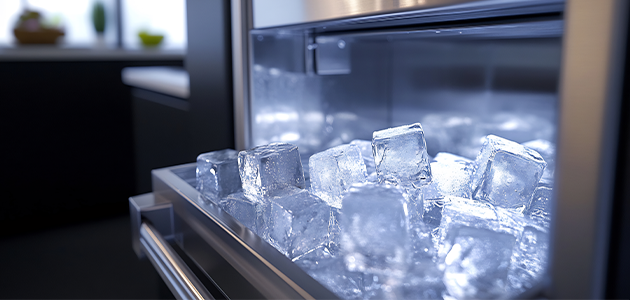
Nothing stalls a bar, cafe, or kitchen line quite like an ice bin that will not fill. Before assuming the worst about the compressor, it helps to know that a commercial ice machine not making ice is usually starved of water, choked on heat, or coated in scale, rather than mechanically broken.
The good news is that most of these causes are easy for an operator to spot and fix, without waiting on a service call or budgeting for a new head. Work through the possibilities in order of likelihood: water supply, water filter, condenser coil, room temperature, then scale on the evaporator. Together, these five explain the overwhelming majority of low production calls, and refrigerant or compressor faults, while real, are comparatively rare.
Below, we'll walk through a quick diagnostic checklist, then rank the nine most common causes so you can troubleshoot before calling in help.
Start With These Four Checks
Each takes under a minute.
-
Power and mode. Switch on ICE, not OFF or CLEAN; breaker on, panel showing a normal cycle.
-
Water at the machine. Trace the line from shutoff valve to inlet, looking for a closed valve or a kinked hose.
-
Bin status. A full bin, a bridged slab, or a frosted sensor tells the control to stop producing.
-
Room temperature. Makers rate maximum output at 70 degrees F air with 50 degrees F water; "standard" production assumes 90 degrees F air with 70 degrees F water.
Symptom to Cause Diagnostic Table
|
Symptom |
Likely cause |
30-second check |
Fix |
|
Cycles, trough dry |
Valve closed, or line kinked |
Open valve, straighten hose |
DIY |
|
Output fades over weeks |
Clogged water filter |
Read the cartridge date |
DIY |
|
Long cycles, hot air off back |
Dirty condenser coil |
Daylight through fins? |
DIY |
|
Output falls each summer |
High ambient or tight clearance |
Thermometer at the intake |
DIY |
|
Slab freezes, will not release |
Scale on the evaporator |
White crust on plate? |
DIY |
|
Overfills or drips in harvest |
Failing inlet valve |
Shut supply, watch for drips |
Tech |
|
Dead with an empty bin |
Bin sensor or thermostat stuck |
Wipe the sensor eye |
DIY, then tech |
|
Runs nonstop, little ice |
Low refrigerant from a leak |
No safe owner check |
EPA tech |
|
Hum, click, then nothing |
Compressor or contactor |
Listen at startup |
Tech |
Commercial Ice Machine Not Making Ice: 9 Causes Ranked by Likelihood
1. Water supply shut off or kinked
The machine cycles, but the trough stays dry. Check the shutoff valve, then the hose behind the unit. Most models want incoming pressure of 20 to 80 psi and water near 40 to 90 degrees F. DIY.
2. Clogged water filter
Cubes come out small, hollow, or slow. A cartridge past its service life restricts flow long before it blocks. Replace roughly every six months, sooner on hard water, and keep a spare commercial water filter on hand. DIY.
3. Dirty condenser coil
Long cycles and hot discharge air point at the coil. Grease and lint pack the fins, heat rejection collapses, and the machine runs longer for less ice. Pull the panel and brush the fins clean. The penalty dirty refrigerator coils cause in a reach-in applies here. DIY.
4. Ambient temperature or clearance
Output that craters in July or after a remodel is an airflow story. Air-cooled heads commonly need 6 to 12 inches of clearance at the sides and top, though your manual is the authority. Boxed in beside a fryer, a unit underproduces no matter how clean it is. If the space cannot change, weigh air-cooled against water-cooled ice machines. DIY unless the unit has to move.
5. Scale buildup on the evaporator
The slab freezes but will not drop, or cubes look cloudy. Calcium and magnesium plate onto the evaporator and act as insulation. Most makers call for a descale and sanitize twice a year. Work through how to clean a commercial ice machine before replacing any part. DIY.
6. Dirty or failed water inlet valve
Water trickles during harvest and refreezes the slab onto the plate, or the trough overfills. Shut the supply and watch for a drip past a closed valve. A grit-filled screen can be rinsed. A valve that will not seat needs a replacement part fitted by a tech.
7. Bin sensor or thermostat stuck
The machine refuses to start with an empty bin, or it runs and overflows. Wipe the sensor eye or probe, break up any ice bridge, and confirm the door seals. Cleaning is DIY. A sensor that still misreads is a tech call.
8. Low refrigerant charge
Your compressor runs nearly nonstop, the evaporator frosts unevenly, and output is a fraction of normal. Sealed systems do not consume refrigerant, so low charge means a leak. Only an EPA Section 608 certified technician may open or recharge it, and the EPA SNAP program lists acceptable refrigerants. Tech only.
9. Failing compressor or contactor
A hum and a click at startup with nothing after, or a breaker that trips. A burned contactor is a modest repair. A failed compressor on an older unit is not. Tech only.
When Repair Stops Making Sense
Slow production is almost always maintenance, not failure. Descale, change the filter, clean the condenser, and measure 24-hour output before pricing anything. Replacement starts to win when:
-
The unit is past the eight- to ten-year mark, and the quote approaches half the cost of a new head.
-
The same fault returns within a season despite clean coils and fresh filters.
-
Water and energy use keep climbing. The ENERGY STAR commercial food service equipment listings show what current models draw.
-
You can no longer keep the interior clean, and the FDA Food Code treats ice as food.
Frequently Asked Questions
Why is my ice machine not making ice but water is still running?
Water moving with no ice points at the freeze side, not the supply. Suspect a fouled condenser coil, room air above 90 degrees F, scale on the evaporator, or an inlet valve that will not close. Clean the coil and descale first, since those steps resolve most calls.
How long should a commercial ice machine take to make a batch?
Cycle times vary by model and conditions. Many cube machines finish a freeze and harvest in roughly 15 to 30 minutes, and makers often cap the freeze cycle near 45 to 60 minutes before forcing a harvest. Time three cycles before cleaning and three after; the trend beats the raw number.
Can I fix low ice production myself?
Most of it, yes. Water supply, filter changes, condenser cleaning, descaling, and sensor cleaning are owner tasks needing only basic tools and an approved cleaner. Anything touching refrigerant lines, sealed system pressure, or the compressor requires an EPA-certified technician under federal rule.
Does a hot kitchen really stop an ice machine from making ice?
It rarely stops production outright, but it cuts output hard. Ratings assume 70 degrees F air for maximum production. Push the room toward 100 degrees F with tight clearances and a greasy coil, and a machine rated for hundreds of pounds a day falls well short.
Next Steps
Run the list top to bottom before calling anyone, and log filter changes and cleaning dates so the next slowdown takes ten minutes, not a service visit. If the machine truly is finished, size a replacement from our commercial ice makers against peak demand, not an average day. Whether that means a PeakCold cuber for steady countertop service or a higher-output Snooker machine with bin, our team can match the model to your rush-hour numbers, not your slow Tuesday afternoon.