
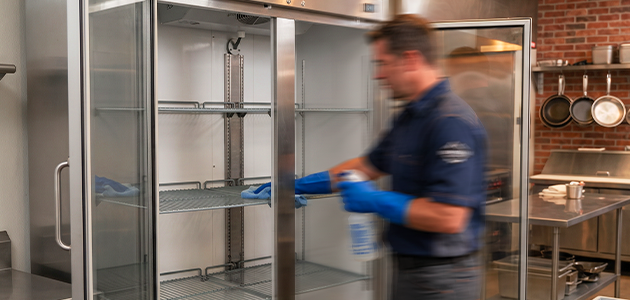
Here is how to clean a commercial ice machine. Shut off power and water, discard the ice, apply a nickel-safe scale remover at the label dilution, run the clean cycle, hand-wash the removable parts and bin, sanitize every food-contact surface with an EPA-registered sanitizer, air dry, and reassemble. Throw out the first batch of ice. The job takes 60 to 90 minutes, and most manufacturers expect it twice a year.
Why Not Cleaning an Ice Machine Is a Health Inspection Risk
Ice is legally food. The FDA Food Code treats it like produce or cooked chicken, which makes the inside of your machine a food-contact surface. Chapter 4 tells operators to clean ice bins and makers at the manufacturer's stated frequency, or as often as needed to prevent soil and mold, then sanitize.
Inspectors know it, and the bin lid is one of the first things they open. Pink or gray film on the water curtain is a violation under the FDA retail food protection program most state codes follow. Equipment built to NSF/ANSI 12, the ice machine standard from NSF International, comes apart for cleaning, but certification does not do the work for you.
Scale vs. Biofilm: Two Problems, Two Chemicals
Operators lose afternoons attacking both with one bottle. These are different failures.
|
Factor |
Mineral scale |
Pink slime and biofilm |
|
Appearance |
Chalky white or gray crust, gritty |
Pink to orange film, slippery |
|
Cause |
Calcium and magnesium in the water supply |
Airborne bacteria and yeast, often Serratia marcescens |
|
Where it shows |
Evaporator plate, trough, distribution tube |
Water curtain, bin walls, gasket, drain |
|
What it does |
Insulates the evaporator, cuts daily output |
Contaminates ice, causes odor, fails inspection |
|
Removed by |
Nickel-safe acid scale remover |
Food-contact sanitizer, after cleaning |
Scale is the most common reason a healthy machine underproduces. If yours runs but the bin never fills, descale first, then work through the other causes of a commercial ice machine not making ice.
How to Clean a Commercial Ice Machine Step by Step
Gather these first:
-
Nickel-safe scale remover approved by your manufacturer
-
EPA-registered sanitizer labeled for food-contact surfaces, no rinse required
-
Two clean buckets, nitrile gloves, eye protection, a soft nylon brush, and lint-free cloths
-
A fresh water filter cartridge and replacement gaskets (parts and accessories)
Then work in order:
-
Let the machine finish its harvest, switch it off, and unplug it or lock out the breaker. Close the water valve.
-
Empty the bin and discard every cube. Do not stage it in another cooler.
-
Drain the water trough or reservoir as your manual specifies.
-
Mix the scale remover with warm water at the label ratio, often 2 to 4 ounces per gallon for concentrates.
-
Pour it into the trough and start the clean cycle. Most circulate for 10 to 20 minutes. Heavy scale needs a second pass.
-
Meanwhile, pull the water curtain, distribution tube, trough, and splash panels. Soak them in the same solution and scrub until they feel smooth, not sandy.
-
Rinse every part with potable water. Wipe the bin, gasket, and drain with warm detergent water, then rinse.
-
Sanitize the evaporator area, curtain, trough, bin walls, and gaskets. Chlorine typically runs 50 to 100 ppm and quat around 200 ppm; the label sets contact time.
-
Air dry. Wiping sanitizer off early defeats it. Reassemble in reverse.
-
Restore water and power, run one production cycle, and discard that first batch of ice.
How Often to Clean an Ice Machine
|
Task |
Standard kitchen |
High volume, greasy, or hard water |
|
Full descale and sanitize |
Every 6 months |
Every 3 months |
|
Bin wipe-down, gasket check |
Weekly |
Twice weekly |
|
Air filter clean or swap |
Monthly |
Every 2 weeks |
|
Condenser coil cleaning |
Every 6 months |
Every 3 months |
|
Water filter cartridge |
Every 6 months |
Every 3 months |
Pizza shops, bakeries, and bars belong in the right column, since airborne flour, sugar, and fryer vapor all feed biofilm. Air-cooled heads pull kitchen air across a condenser, so their filters need attention, whereas a water-cooled unit does not. See air-cooled vs. water-cooled ice machines. Log the machine with your other cold storage using our notes on how often to clean a fridge.
Water Quality Does Most of the Work
Scale is a water problem before it is a cleaning problem. Anything above roughly 7 grains per gallon counts as hard water, and at that level an evaporator re-crusts within months no matter how well you scrubbed. A scale-inhibiting cartridge slows that cycle and strips chlorine taste and sediment, which is what guests notice in a glass. Size your commercial water filters to the machine's rated daily output.
Mistakes to Avoid
-
Household bleach on the evaporator. Chlorine attacks nickel and tin plating and can void your warranty. Use nickel-safe chemistry on the water circuit, and never mix cleaner with sanitizer.
-
Skipping the sanitize step. Descaling removes minerals. It does not kill biofilm.
-
Serving the first batch. It carries chemical residue and loose debris.
-
Ignoring the bin drain. Standing water is where pink slime starts.
Frequently Asked Questions
How often should you clean a commercial ice machine?
Deep clean and sanitize at least every six months, the baseline nearly every manufacturer expects. Move to quarterly if you run high volume, sit on hard water, or work a greasy kitchen. Wipe the bin weekly and change the air filter monthly in between.
What causes pink slime in an ice machine?
Pink or orange slime is biofilm, usually Serratia marcescens, a bacterium that drifts in on kitchen air and settles on wet surfaces with trace nutrients. Bins, water curtains, and gaskets are its favorite spots. Descaler will not touch it. Removal takes a detergent wash, then a food-contact sanitizer.
Can you use bleach or vinegar to clean an ice machine?
Not on the water circuit. Household bleach corrodes nickel-plated and tin-plated evaporators, and vinegar is too weak for real scale. Coffee-equipment descalers are not built for plated surfaces either. Use a nickel-safe scale remover for minerals and an EPA-registered food-contact sanitizer for bacteria, both approved by your manufacturer.
Do you have to throw away ice after cleaning the machine?
Yes. Discard everything in the bin before you start, plus the entire first batch produced after the restart. That batch can carry cleaner or sanitizer residue, and debris loosened during the process. Once the second batch drops clean, you are back in service.
Building a Routine That Actually Sticks
Post the schedule on the machine, assign it to a named manager, and keep a signed log. Inspectors respect documentation, and a clean evaporator holds its rated output far longer than a neglected one. If your unit is scaled beyond recovery or undersized for your bar volume, browse our commercial ice makers for a cuber or flaker matched to demand. Whether you need a compact PeakCold undercounter unit or a higher-volume Snooker machine with bin, our team can match the model to your daily ice demand.