
Picture this: the lunch bell rings, and 300 hungry students flood the cafeteria with exactly 25 minutes to eat before the next class. But they’re not eating. They’re standing in a school lunch line that’s barely moving, watching precious minutes tick away. By the time some kids reach the front, they’ve got maybe ten minutes to actually eat.
Here’s the thing: the solution isn’t extending the lunch period (good luck getting that approved). It’s fixing the physical bottleneck nobody’s talking about: your milk cooler.
Key takeaways for cafeteria directors:
- Double your serving capacity with the same floor space
- Keep 41°F compliance during 2-hour service windows
- Turn milk distribution into a 100% self-serve operation
- Protect equipment investment with mobile, durable designs
- Cut down line congestion for elementary through high school campuses
The 25-Minute Countdown: Solving Long Lines Forming in the Cafeteria
You’ve got a narrow window to feed hundreds of students, and every second counts. Most cafeteria directors invest in faster POS systems, streamlined menus, and even extra registers. But the cafeteria line still crawls because there’s a traffic jam happening at the cold beverage station that no software upgrade can fix.
Your milk cooler isn’t just storage. It’s a critical piece of serving equipment that’s either facilitating flow or slowing it down. And if your current setup requires students to form a single-file line while staff members hand out cartons one by one, you’re wasting everyone’s time.
The “Two-Line” Tactic: How Serving Equipment Placement Cuts Wait Times
Most school cafeterias push their milk cooler against a wall because that’s where the outlet is. This creates a single-access point that forces students into one slow-moving queue, wasting valuable space and minutes. But here’s what schools managing high-volume cafeterias have figured out: flow isn’t about speed. It’s about access.
The real problem shows up during restocking. When staff have to drag heavy crates through the front of the line mid-service, everything stops. Students wait. Staff scramble. And that lunch period gets shorter and shorter.
Doubling Throughput for High Schools and Large Campuses
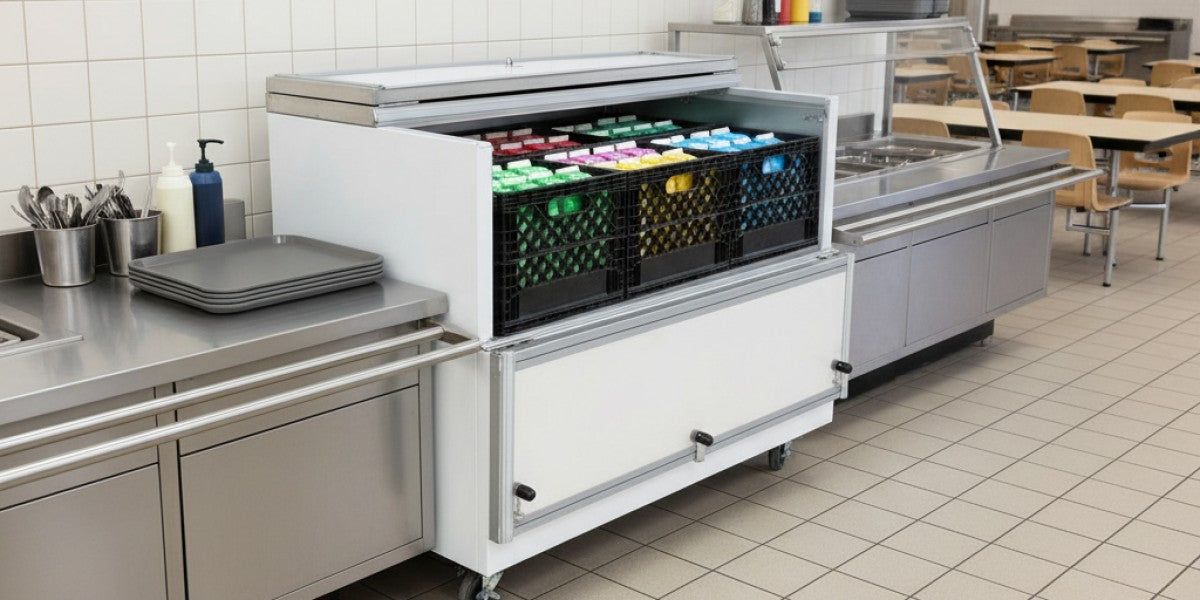
The island configuration flips the script entirely. Place your commercial milk refrigerator between two serving lines, and suddenly, students can access cold beverages from both sides simultaneously. You’ve just doubled your service rate without hiring additional staff or extending the lunch period.
This setup is a game-changer for high schools and large elementary campuses, where improving school lunch line efficiency can mean the difference between kids actually eating lunch or skipping it altogether. Two streams of students, one piece of equipment, zero collisions.
Streamlining the Flow of Hot and Cold Foods
Here’s the operational hack that kitchen staff love: rear-access restocking. While students grab milk cartons from the front, your team loads fresh crates from the back (kitchen side). The serving process never stops. The line keeps moving. Nobody’s dragging 40-pound crates through a crowd of first-graders.
This configuration means your hot and cold food stations can operate simultaneously without staff crossing paths or creating new cafeteria bottleneck solutions mid-service. It’s simple physics applied to lunch logistics.
The “Open-Lid” Challenge: Ensuring Cold Foods Stay Safe
A faster line doesn’t matter if your milk spoils halfway through service. And that’s the unique challenge of cafeteria lunch lines: you need to keep cartons at 41°F or below while the cooler lid stays wide open for two straight hours. Standard cold-wall coolers can’t handle this. They lose cold air the second you lift the lid, putting your entire school nutrition program at risk during health inspections.
The solution isn’t checking temperatures every thirty minutes and hoping for the best. It’s forced-air refrigeration that actively maintains safe temperatures even under the most demanding conditions.
Why Standard Commercial Refrigerator Designs Struggle
Cold-wall technology works great when the lid stays closed. The moment you open it? That cold air escapes immediately, and you’re relying on thermal mass alone to keep things safe. It’s like opening your freezer and expecting everything to stay frozen while you rearrange your shelves.
Forced-air systems create a constant circulation pattern: a “curtain” of cold air that flows over the cartons continuously. The last milk carton served at 1:45 PM is just as cold as the first one grabbed at noon. No temperature anxiety, no constant lid adjustments, no failed inspections.
Staff Optimization: Improving the Serving Process with Self-Serve Stations
Your trained cafeteria staff shouldn’t be standing at a milk station handing out cartons to students who are perfectly capable of grabbing their own. That’s skilled labor performing a task that equipment should be handling, especially when those same staff members are needed at registers, supervising lines, or managing dietary restrictions.
The problem compounds with younger students who physically can’t reach the bottom crates. So staff stop what they’re doing, walk over, lift the panel, grab a carton, and hand it down. Repeat. Meanwhile, the cafeteria line backs up.
Removing Barriers for Younger Students
Drop-down front panels turn your school milk cooler into a genuinely self-serve station. As the top crates empty, the front panel folds down automatically, giving even kindergarteners easy access to the bottom row. No staff intervention required. No line disruption. No wasted labor on repetitive tasks.
This single feature frees up your team to focus on what matters: managing flow, handling special dietary needs, and keeping the overall serving equipment running smoothly.
Tasks You Can Stop Doing:
- Opening milk cartons for younger students
- Stopping the line to rotate the bottom crates to the top
- Manually checking temperatures every 30 minutes
- Restocking from the front during service
Flexibility & ROI: Protecting Valuable Space and Budget
School equipment takes a beating. Students bump it, carts collide with it, and spills happen between lunch waves. Plus, your layout needs to change constantly. You might need to roll the cooler into the gym for a breakfast program or create a satellite lunch station for an outdoor event.
This means your commercial milk refrigerator needs three things: mobility, durability, and cleanability. Without those, you’re replacing equipment every few years instead of getting a decade or more from your investment.
Heavy-duty locking casters let you reposition the unit anywhere, instantly creating flexible serving areas that adapt to your space. Stainless steel construction protects against daily abuse: those inevitable kicks, cart collisions, and general wear down cheaper equipment within a couple of years.
And when someone inevitably knocks over a crate of milk between lunch periods? Stainless steel interiors with floor drains mean you spray it down, drain it out, and get back to service. No sticky floors, no lingering smell, no maintenance headaches that slow down your next lunch wave.
Skip Lunch Altogether? Not Anymore.
The right milk cooler transforms your cafeteria from a race against the clock into a smooth operation where students actually have time to eat. It’s about logistics as much as cooling: understanding that every piece of serving equipment either facilitates flow or disrupts it.
When students can move through the lunch line quickly, grab what they need independently, and trust that the milk will be cold and safe? That’s when lunch periods start working the way they’re supposed to. Kids eat. Staff breathe easier. Health inspectors see properly maintained cold foods. Everybody wins.
Don’t let inadequate equipment be the reason long lines form, keeping kids from eating. Browse Iron Mountain’s commercial milk coolers and find the configuration that fits your space, your volume, and your budget.
Common Questions About Commercial Refrigerator & Milk Cooler Setup
Do I need to buy special milk crates to fit these coolers?
No need. These units are designed around standard 13″×13″×11″ dairy crates (the same ones 99% of suppliers use). If you’re using standard square crates from your current dairy vendor, they’ll slide right in without modification.
How do I keep the forced-air system from clogging with cafeteria dust?
Any active cooling system needs airflow to work properly. These units feature bottom-mounted compressors with accessible coils that you can brush down during monthly maintenance checks. Five minutes of prevention keeps the air circulating freely and the unit running efficiently for years.
My cafeteria only has standard wall outlets. Do these require special wiring?
Most models run on standard 115V outlets (NEMA 5-15P), the same plug you’d use for any kitchen appliance. You typically won’t need an electrician to upgrade your electrical system just to add a milk station. The larger 16-crate units might require different specs, but your standard configurations plug right in.
What happens if a caster gets damaged from daily use?
It happens. Schools are demanding environments. That’s why these units use industrial-grade casters that bolt directly to the frame, not cheap plastic inserts that crack under pressure. If one does get bent crossing a threshold or from a cart collision, you can replace the individual caster without scrapping the entire unit. Simple bolt-off, bolt-on repair that any maintenance team can handle.